 By LA SAVEUR VANILLE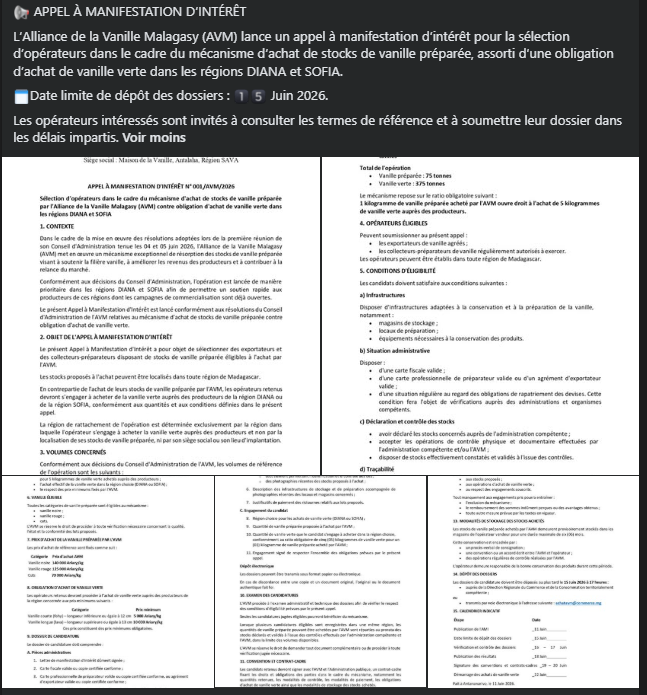
On June 11, 2026, the Alliance for Malagasy Vanilla (AVM) launched a call for expressions of interest aimed at selecting operators to participate in a program involving the purchase of prepared vanilla stocks. The initiative also requires participating companies to purchase green vanilla beans from the DIANA and SOFIA regions.
Beyond the administrative announcement lies a critical question: why is Madagascar intervening in the vanilla market now, and what could this mean for producers, preparers, exporters, and international buyers?
A market still facing significant stock levels
Over the past several years, the global natural vanilla market has been undergoing a period of adjustment. Following the historic price surge experienced between 2017 and 2019, international demand gradually stabilized while production volumes remained relatively high.
As a result, significant inventories accumulated across the supply chain. For many vanilla preparers and traders, these stocks represent substantial financial assets tied up in storage, limiting their ability to purchase new crops or invest in their operations.
The AVM initiative appears designed to address this issue by facilitating the absorption of part of the existing prepared vanilla inventory.
Why purchase prepared vanilla stocks?
At first glance, the measure may seem unusual. However, it follows a straightforward economic rationale.
When inventories become excessive, operators tend to reduce their purchasing activities. This caution eventually affects the entire supply chain, including vanilla farmers.
By encouraging the purchase of existing prepared vanilla stocks, the AVM aims to improve market liquidity and restore confidence among industry participants. The goal is not merely to reduce inventories but also to create conditions that allow commercial activity to resume more smoothly.
In other words, the initiative seeks to prevent excess stock from creating a prolonged market slowdown.
The green vanilla purchase requirement: The core of the strategy
Perhaps the most significant aspect of the program is the obligation imposed on selected operators to purchase green vanilla beans from the DIANA and SOFIA regions.
This requirement clearly indicates that the initiative is not solely intended to help stockholders. It is also designed to support economic activity in producing regions.
Without active buyers, vanilla farmers could face lower prices or difficulties selling their harvests. By linking the purchase of prepared vanilla stocks to the purchase of fresh green vanilla, the AVM aims to maintain product flow throughout the supply chain.
This approach demonstrates an effort to protect not only commercial operators but also the livelihoods of vanilla producers.
Who could benefit from this initiative?
Vanilla farmers
If successfully implemented, the mechanism could help maintain demand for green vanilla beans and reduce downward pressure on farm-gate prices.
Vanilla preparers
Companies holding large inventories may improve their cash flow by reducing stock levels that have been tied up for months or even years.
Exporters
A more fluid market environment could help exporters secure supplies more efficiently and operate with greater confidence.
The industry as a whole
The initiative may contribute to reducing imbalances between available supply and actual demand while improving overall market stability.
Challenges and limitations
Despite its potential benefits, the program is not a complete solution to the industry’s challenges.
The most important issue remains global demand. Even if inventories are partially absorbed, the key question persists: will international consumption of natural vanilla increase in the coming years?
The success of the initiative will also depend on the number of operators capable of meeting the financial and operational requirements established by the AVM.
As with any market intervention, its effectiveness will need to be assessed over time to determine its actual impact on prices, inventories, and producer incomes.
A new phase in Malagasy Vanilla Governance
Beyond its immediate operational objectives, this call for expressions of interest sends a strong signal to the entire vanilla industry.
Since the creation of the Alliance for Malagasy Vanilla and the restructuring of industry governance, Madagascar has shown a growing willingness to play a more active role in regulating and organizing the vanilla sector.
The objective is clear: to avoid the market imbalances that have affected the industry in recent years and to create a more stable environment for farmers, preparers, exporters, and international buyers.
The June 2026 initiative therefore represents one of the first major practical tests of this new governance framework.
Conclusion
The AVM’s call for expressions of interest goes far beyond a simple administrative procedure.
It reflects some of the most pressing challenges facing Madagascar’s vanilla industry today: inventory management, producer income protection, market balance, and long-term stability.
If successful, the initiative could help restore liquidity and confidence across the supply chain. If not, it will serve as a reminder that the industry’s long-term health ultimately depends on sustainable growth in global demand.
One thing is certain: this decision marks a new chapter in the evolution of Madagascar’s vanilla sector and deserves close attention from all industry stakeholders worldwide.